
CLIMATE FINANCE INTELLIGENCE
Knowledge Management for Climate Finance
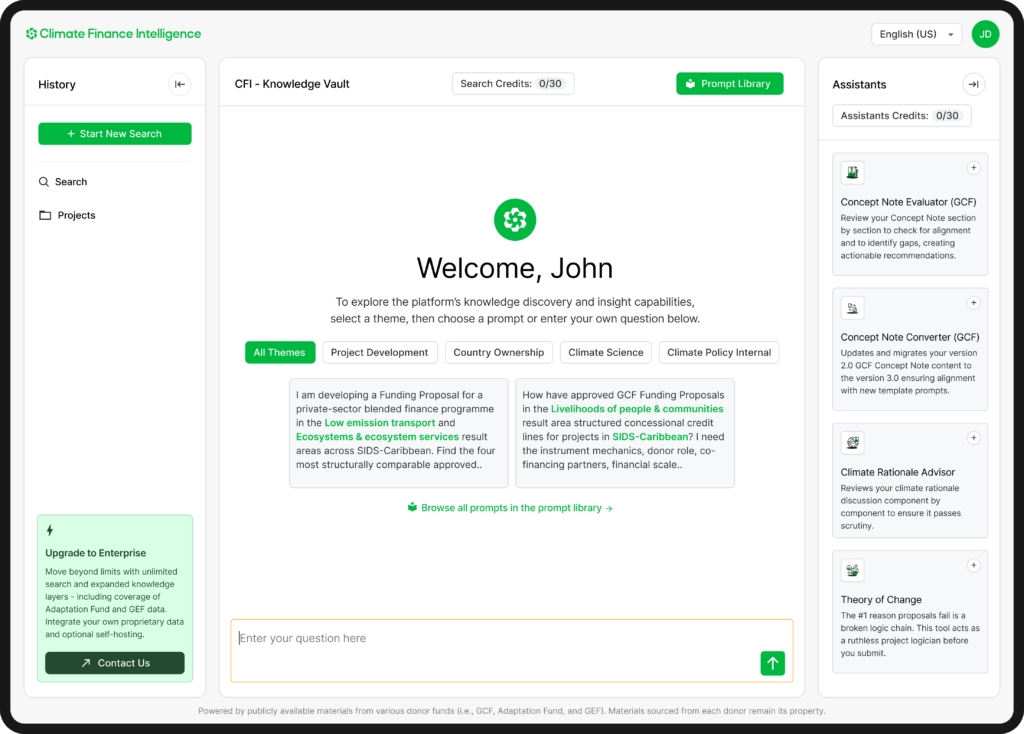
Built specifically for teams developing climate finance proposals, Climate Finance Intelligence turns static documents both internal and external into an instantly searchable knowledge base, delivering critical insights and donor alignment in seconds, not weeks.
"Integrating this software into our workflow means we can deliver superior quality proposals faster. This isn’t about replacing expertise; it’s about amplifying it, allowing our team to be more strategic and effective in this industry."






The stakes are high: General-purpose AI isn't built for this
Generic AI infers answers from the open web - hallucinations, no traceability, and an agreeable streak that hands you whatever case your prompt implied. CFI is anchored to documents you own or are authorized to use. Every finding is tied to verifiable source text, with an emphasis on critical evaluation over affirmation.
Built On Your Own Files
CFI is populated with the materials you own or are authorized to use: your past submissions, technical notes, and the external sources you select. It is a strictly private - your dataset is never shared and never used to train AI models.
Every Insight Is Cited
Each response traces to specific source text. Built-in references let you verify exactly where a finding comes from - not inferred, not paraphrased, not invented.
Critical In Evaluation
The platform can only draw on what's in your dataset, so it cannot manufacture support that isn't there. The assistants are configured to evaluate critically rather than just agree.
The intelligence behind the platform
Climate Finance Intelligence is built on three powerful layers designed to rapidly deliver precise insights across a wide range of complex and analytical questions.
One question, all three layers
An Accredited Entity Analyst asks:
“We’re preparing an ecosystem-based adaptation proposal for a strategic water-source area – what have we done before, what has the GCF approved, and what’s the climate evidence?”
CFI Returns in Seconds:
- The entity's prior EBA projects in comparable water-source areas, with results and lessons learned.
- Comparable GCF-approved adaptation proposals with theory of change and co-financing.
- The peer-reviewed climate evidence most cited in approved water-security proposals.
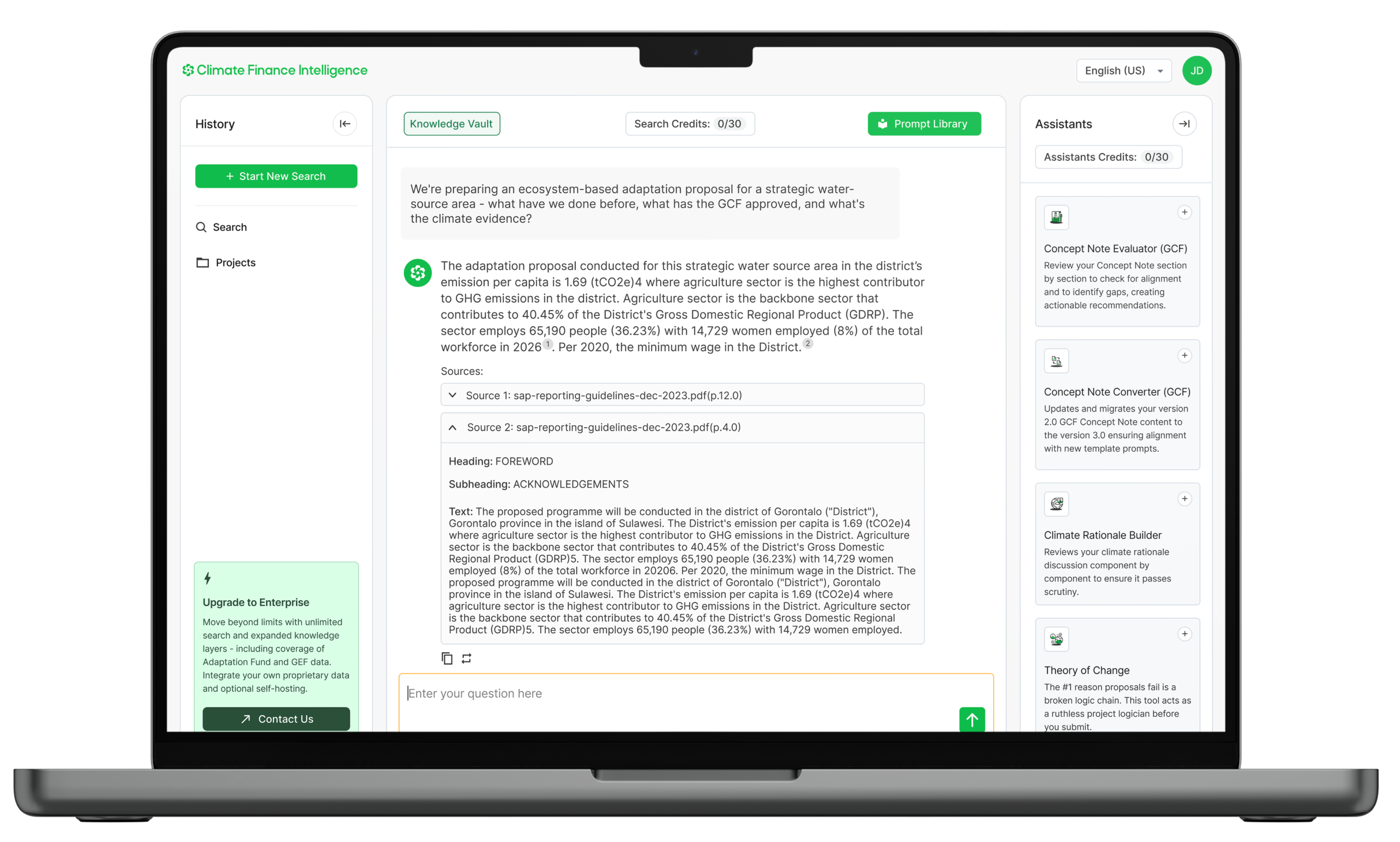
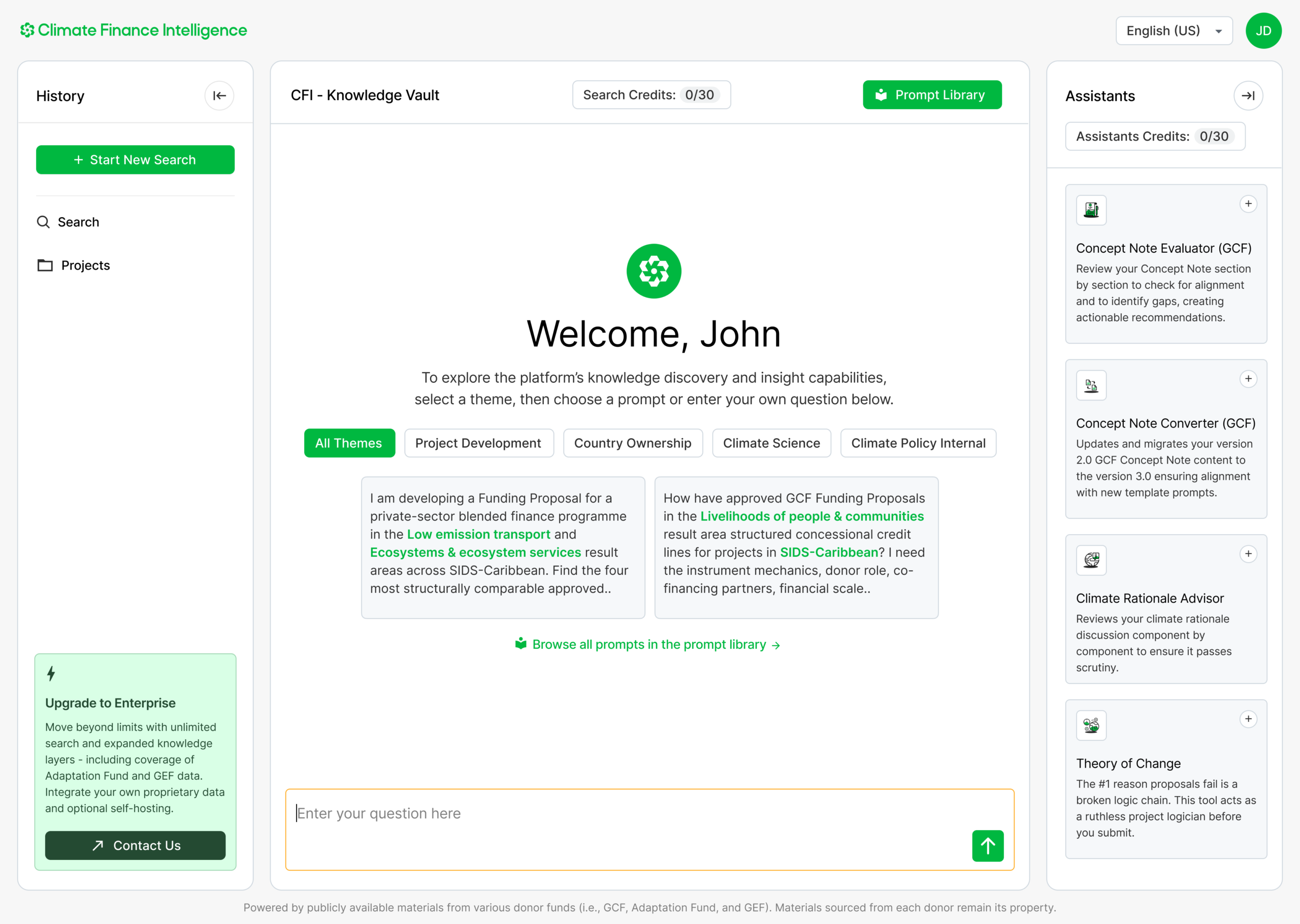
Step 1: Select a Theme-Based Prompt or Enter Your Own Question
After creating your CFI account, select a theme and explore example prompts in the main screen or prompt library. Choose a prompt, update the fields if needed and click submit or enter your own question.
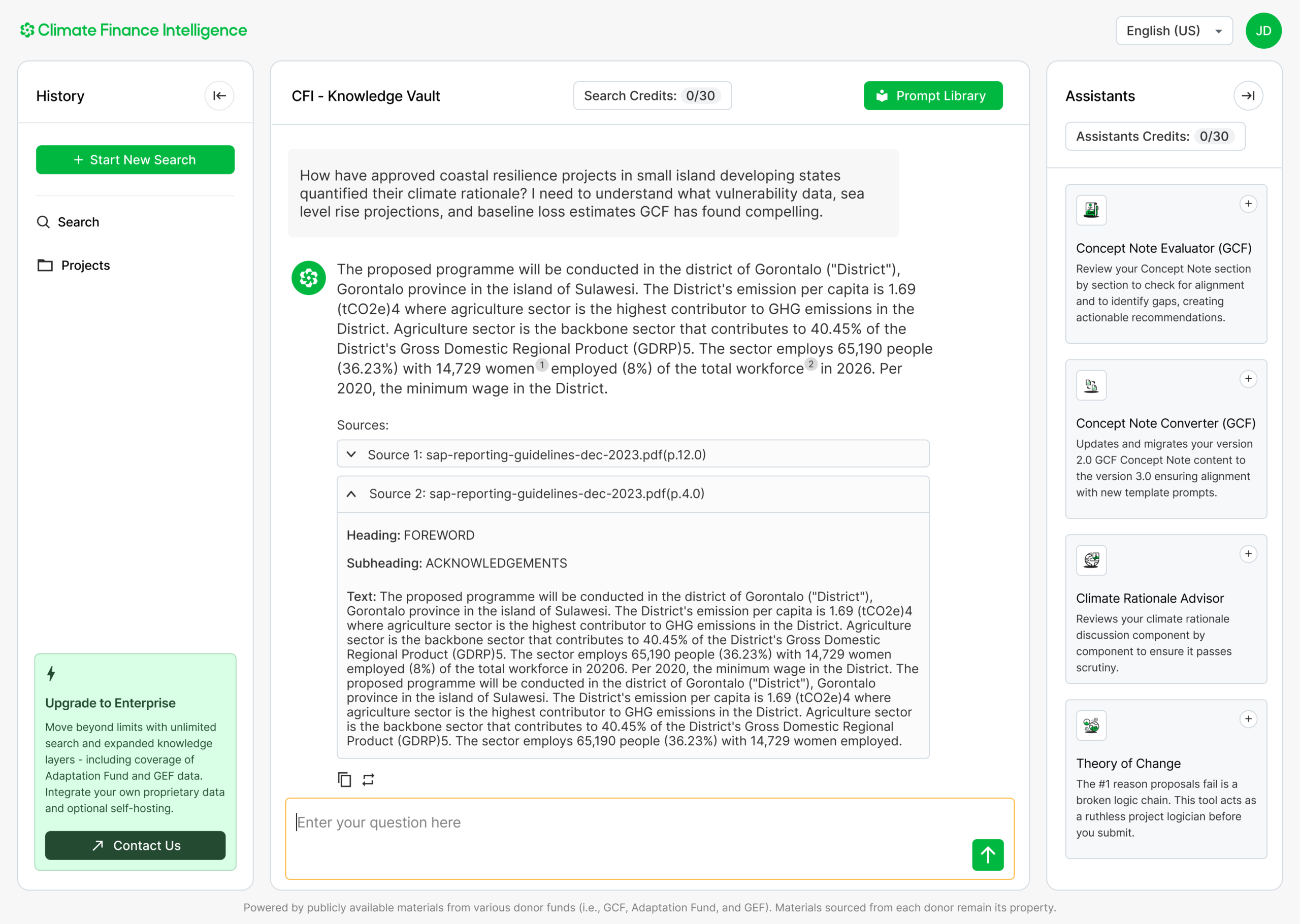
Step 2: Review the Output & Sources
Once you've submitted your prompt or question, in a few seconds a generated output with verifiable source citations will display. Review the output and feel free to continue the conversation by asking follow-up questions to refine the results.
HOW IT WORKS
The Knowledge Vault
Don't just guess - build. Instantly access proven models, logic and arguments from thousands of approved project files to strengthen and align your submissions.
PRICING
Simple, credit-based pricing
Each tier includes a bundle of Assistant Credits and Search Credits. The Knowledge Vault (KV) is a database grounded in an indexed corpus of approved proposals that facilitates insight surfacing and more.
Enterprise
$95,000
One-time perpetual license
Annual Infrastructure Cost
$3,000 – $10,000 (customer-controlled)
Managed Infrastructure Service
$8,000 – $12,000/year (optional)
Deployment Options
Self-managed · Janus-managed cloud
Two ways to get expert output
Six tools to resolve your biggest pain points. Use our specialized assistants or request a comprehensive report to solve complex use cases with speed and accuracy.
- Self-Serve Run: $500 (500 credits)
- On-demand report: $1,000 USD (2-3 day delivery)
- Ideal For: Concept Note Development
- How to Pay: Payment link (credit card)
- Self-Serve Run: $500 (500 credits)
- On-demand report: $1,250 USD (2-3 day delivery)
- Ideal For: Concept Note Development
- How to Pay: Payment link (credit card)
- Self-Serve Run: $1,500 (1,500 credits)
- On-demand report: $2,500 USD (3-4 day delivery)
- Ideal For: Funding Proposal Development
- How to Pay: Payment link (credit card)
- Self-Serve Run: $500 (500 credits)
- On-demand report: $1,000 USD (2-3 day delivery)
- Ideal For: Concept Note and Funding Proposal Development
- How to Pay: Payment link (credit card)
- Self-Serve Run: $500 (500 credits)
- On-demand report: $1,250 USD (2-3 day delivery)
- Ideal For: Project Development at the pre-FP stage.
- How to Pay: Payment link (credit card)
- Self-Serve Run: $700 (700 credits)
- On-demand report: $2,500 USD (3-4 day delivery)
- Ideal For: Concept Note and Funding Proposal Development
- How to Pay: Payment link (credit card)
FAQs
We’ve covered the most frequently asked questions below. If you have any additional questions, contact us at anytime.
CFI is a specialist enterprise platform, not a general-purpose chatbot. Key differences:
- Single-tenant architecture: Your instance is dedicated to your organization. No shared infrastructure with other clients.
- Three integrated knowledge layers: CFI searches across 3,000+ approved GCF project files, 100+ authoritative climate science publications, and your own institutional documents simultaneously. Commercial AI tools have none of this.
- Zero-retention architecture: No prompt or session data is retained or logged after a query completes. Commercial AI tools retain and may train on your data.
- Agentic AI assistants: Purpose-built assistants evaluate Concept Notes and Funding Proposals against donor criteria and scoring guidance. Commercial AI cannot replicate institutional knowledge of GCF evaluation standards.
- Institutional memory: CFI retains and compounds knowledge across staff rotations and consultant departures. Commercial AI starts from zero every session.
CFI operates on a zero-retention architecture — no prompt or session data is retained or logged after a query completes. All data is processed strictly in-memory to generate a response and then permanently discarded. No human review occurs, and no data is used for model training. The platform is hosted on dedicated VPS infrastructure in a certified German data centre with AES-256 encryption at rest and TLS 1.2+ encryption in transit. Each client operates on a dedicated instance — no shared infrastructure with other clients. Google has granted Janus a formal, written exception to its standard prompt logging policy, ensuring zero retention at the AI inference layer as well. Self-hosting on your own cloud infrastructure is also available.
CFI is delivered as a professional services engagement, not a software subscription. Enterprise pricing is estimated at $25,000 USD per year, structured across a four-year engagement period — a total programme cost of $100,000 USD. The client retains full ownership of all configured tools, knowledge layers, and documentation throughout and beyond the engagement. On-demand analytical services — such as individual Concept Note evaluations and co-financing benchmarks — are available separately and independently of the enterprise engagement.
Yes. CFI is positioned as an institutional capacity-strengthening activity under GCF Readiness and Preparatory Support funding. GCF's own Readiness Guidebooks explicitly fund digital Knowledge Management Systems for Direct Access Entities, and CFI is purpose-built to meet those requirements. Several Accredited Entities are currently incorporating CFI into their readiness proposals.
CFI integrates three knowledge layers:
- Layer 1 - Donor Knowledge: The complete approved GCF corpus, indexing over 3,000 project files including Concept Notes, Funding Proposals, PPF applications, Board decisions, and framework papers.
- Layer 2 - Climate Science: Approximately 100+ verified open-access publications from the most authoritative bodies in the field (IPCC, World Bank, AfDB, UNEP, WMO, WHO) — the sources most frequently cited in approved GCF submissions.
- Layer 3 - Institutional Knowledge: Your organization's own submission history, internal technical notes, and project files — preventing the loss of institutional memory when staff rotate or consultants depart.
One query searches all three layers simultaneously.
The platform's donor knowledge layer is built on the complete GCF corpus, and coverage extends to the Adaptation Fund and GEF. AI assistants are calibrated to GCF and Adaptation Fund submission standards. Additional donor knowledge layers — such as AfDB, EIB, World Bank, and bilateral climate funds — are available on a separately scoped basis.
No. CFI does not generate AI content on behalf of clients for submission to the Secretariat. It provides evidence-based intelligence and quality assurance to support your own preparation and review processes. The platform empowers your team with the knowledge and benchmarks to produce stronger submissions — the drafting and decision-making remain with your team.
CFI includes task-specific agentic AI assistants configured and delivered as part of the professional services engagement:
- Primary Insights Search: Surfaces comparable approved projects with their theory of change, co-financing structure, and design features.
- First Draft CN Builder: Produces a structured first-draft Concept Note aligned to GCF or AF templates, anchored in approved precedent.
- Concept Note Reviewer: Stress-tests a draft CN against comparable approved CNs, flagging gaps in climate rationale, theory of change, and investment criteria.
- Funding Proposal Reviewer: Section-by-section audit of any FP against the full corpus, ranking corrective actions by scoring impact.
- GCF Reviewer Response Assistant: When the Secretariat sends review comments, surfaces how comparable approved proposals addressed the same issues.
The platform also includes several hundred pre-built prompts for Environmental and Social Safeguards (ESS) and Monitoring, Evaluation, Accountability and Learning (MEAL) workflows.
CFI uses a Retrieval-Augmented Generation (RAG) architecture that grounds every response in curated, verified source documents. Responses cite specific approved projects and publications from the knowledge layers — not generated text. AI assistants are configured with constrained output structures and evaluation criteria drawn directly from donor guidance. This architecture significantly reduces the hallucination risk associated with general-purpose AI tools. The human-in-the-loop approach ensures that domain experts review and act on insights, not raw AI output.

Request a demo
Ready to see Climate Finance Intelligence in action? Book a demo today to see how it can solve all of your climate finance bottlenecks and use cases.